
Polyaspartic resin is a key raw material for high-solids, low-VOC, fast-curing two-component coating systems. Its value goes beyond “fast drying”. It gives formulators room to design coatings with high solids, low VOC, an adjustable working window, good weatherability, abrasion resistance, chemical resistance, and fast return-to-service performance.
What Is Polyaspartic Resin?
Polyaspartic resin is an aliphatic reactive resin that contains secondary amine groups. Polyaspartic ester resin is typically produced by reacting a primary amine with a maleate ester. Direct reaction products can already deliver high solids content. Further purification helps reduce residual free fumarate and other by-products, making the resin better suited to systems with stricter requirements for odor, VOC, clear-coat appearance, or environmental performance.
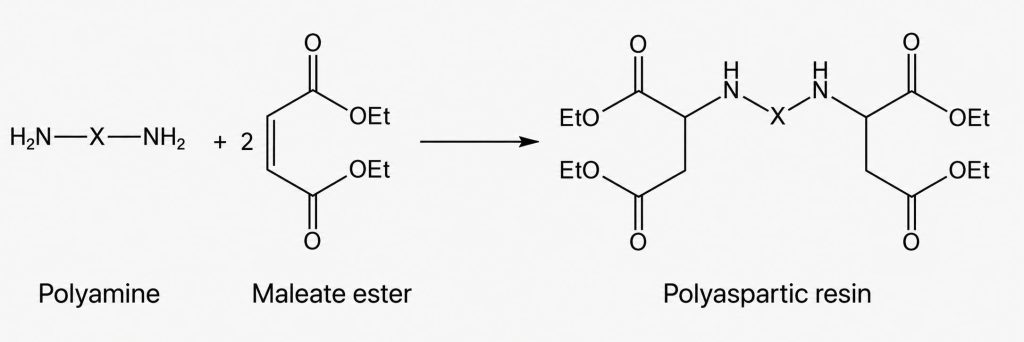
The aspartic ester structure moderates secondary-amine reactivity through steric hindrance and electron-withdrawing effects. As a result, the system can still cure quickly while giving applicators a longer working window than traditional spray polyurea.
For coating manufacturers, this structure offers several practical formulation benefits:
- More room for high-solids formulation
- Low VOC potential
- Adjustable gel time
- Longer pot life than spray polyurea
- Fast tack-free and hard-dry performance
- Good weatherability and yellowing resistance
- Compatibility with HDI, IPDI, HMDI, and modified isocyanate hardeners
- Suitable for roller, squeegee, brush, and spray application
This is why PAE resin is widely used in high-performance flooring, waterproofing, corrosion-resistant topcoats, wind power materials, sealants, adhesives, and industrial protective coatings.
How Polyaspartic Resin Works in Two-Component (2K) Coating Systems
In a two-component system, polyaspartic resin works as the active hydrogen-containing resin component. Its secondary amine groups react with the NCO groups in the isocyanate hardener to form a high-performance polyaspartic polyurea film. The curing reaction can be simplified as follows:
Polyaspartic resin + Isocyanate hardener → Polyaspartic polyurea film
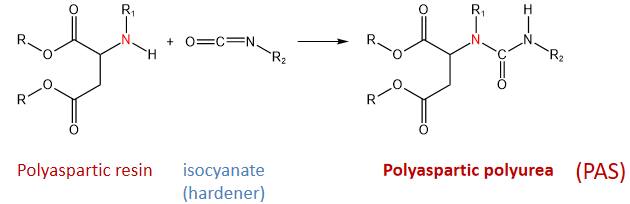
The NCO/NH ratio is critical. The resin side provides secondary amine groups, and the hardener side provides NCO groups. If the ratio is too low or too high, it can affect hardness, flexibility, chemical resistance, tack-free time, hard-dry time, and long-term coating performance.
Hardener selection is also a key part of formulation design. Different isocyanate hardeners can change drying speed, flexibility, hardness, chemical resistance, elongation, and the final feel of the coating film.
| Hardener Type | Typical Use in Polyaspartic Systems |
| HDI trimer | Weather-resistant topcoats, flooring systems, clear coats, corrosion-resistant topcoats |
| HDI prepolymer | Elastic waterproofing layers, flexible protective coatings |
| IPDI prepolymer | Specialty weather-resistant or elastic systems |
| HMDI / TDI modified prepolymer | Waterproofing, adhesives, sealants, and elastic materials |
Epoxy, Spray Polyurea and Polyaspartic Coating: Key Differences
Epoxy, spray polyurea, and polyaspartic coatings are not simple substitutes for one another. Each system has its own strengths in solids content, working window, equipment requirements, weatherability, and application efficiency.
| Comparison Item | Epoxy System | Spray Polyurea System | Polyaspartic System |
| Typical chemistry | Epoxy resin + amine hardener | Amine component + isocyanate | Polyaspartic ester resin + isocyanate |
| Solids content | Typically 70%–100%, while solvent-free epoxy systems are very common and well established. | Usually close to 100% | Usually 70%-100%, suitable for ultra-low VOC or 100% solids formulations |
| Reaction speed | Medium to slow | Extremely fast, often gels within seconds | Adjustable, from fast cure to a longer working window |
| Pot life / working window | Usually long, sometimes over 4 h | Very short | Adjustable by formulation, commonly around 30 min-2 h |
| Application Methods | Roller, brush, spray | Mainly high-pressure spray | Roller, brush, squeegee, spray |
| Equipment requirement | Low to medium | High; special equipment is usually required | Low to medium |
| UV resistance | Usually weak and often requires topcoat protection | Standard aromatic systems usually yellow and chalk easily | Aliphatic systems usually perform better and can be used for weather-resistant topcoats |
| Single-coat film build / application efficiency | Self-leveling epoxy can achieve a thickness of more than 2 mm in a single coat. | Suitable for thick-film application, usually above 1 mm | Can build relatively high film thickness in one coat, commonly around 150-500 μm, while balancing efficiency and appearance |
| Return-to-service speed | Usually slow | Very fast | Fast; suitable for quick recoating and fast reopening |
| Main advantages | Adhesion, chemical resistance, cost control | Thick film, waterproofing, protection, impact resistance | Fast cure, weatherability, low VOC, flexible application methods |
| Main limitations | Yellowing, slow cure, longer downtime | High equipment cost, extremely short working window, harder-to-control appearance | Sensitive to moisture; resin, hardener, and application conditions must be properly matched |
Epoxy systems are still well suited for primers, heavy-duty corrosion protection, and high-adhesion systems. Spray polyurea is a good fit for thick-film waterproofing, protective linings, and fast spray application. Polyaspartic systems sit between the two: they cure faster and offer better weatherability than many epoxy systems, while being easier to apply with common coating methods than traditional spray polyurea. With the right formulation and testing, polyaspartic coatings can deliver high solids, a workable pot life, fast cure, and good outdoor durability.
Key TDS Parameters for Polyaspartic Resin Selection
When selecting a polyaspartic resin, manufacturers should not focus only on drying speed. Viscosity, solids content, equivalent weight, amine value, gel time, and pot life are all important for formulation design.
| Parameter | Why It Matters in Formulation |
| Viscosity | Affects flow, leveling, defoaming, pigment and filler dispersion, and the application feel of 100% solids formulations |
| Solids Content | Affects VOC, film build, and formulation space |
| Equivalent Weight | Used to calculate the NCO/NH ratio |
| Amine Value | Indicates active amine content |
| Gel Time | Shows the relative reaction speed with the hardener |
| Pot Life | Gives a more practical view of the real working window |
| Tack-Free Time | Affects dust resistance, recoating, and jobsite reopening time |
| Hard Dry | Affects handling, sanding, packaging, and return to service |
In Feiyang Protech’s FEISPARTIC polyaspartic resin series, different grades vary clearly in viscosity, equivalent weight, and gel time, making them suitable for different formulation needs.
| Grade | Viscosity mPa·s / 25°C | Solids Content | Equivalent Weight | Gel Time | Typical Formulation Use |
| F220 | 60-100 | 97±2% | 230 | 2 min | Ultra-fast cure, low viscosity, special fast-dry systems |
| F420 | 800-2000 | 97±2% | 277 | 18 min | Standard fast-dry grade for flooring, corrosion protection, waterproofing, and adhesives |
| F423 | 800-2500 | ≥99.5% | 277 | 26 min | Low free monomer, high solids, low VOC systems |
| F449 | 200-500 | ≥98.0% | 267 | 26 min | Low viscosity, good adhesion, medium cure speed |
| F424 | 400-800 | ≥99.0% | 333 | 36 min | Low viscosity with good application properties |
| F2850 | 70-140 | 97±2% | 290 | 60 min | Low viscosity; can be used as a reactive diluent option in flooring systems |
| F520 | 800-2000 | 96±2% | 290 | 130 min | Long pot life for large-area application, corrosion protection, and wind power |
| F523 | 800-2000 | ≥99.5% | 290 | 130 min | Low free monomer with a long working window |
| F528 | 800-2000 | 96±2% | 290 | 180 min | Slower-reacting systems |
In real formulations, fast-reacting resins are useful for fast-dry flooring, small-area repair, and quick return-to-service systems. Long pot life resins are better suited to large-area application, corrosion-protection spraying, wind power coatings, and thick-film systems. When needed, fast and slow resins can be blended to balance tack-free time, hard-dry time, and working window.
Polyaspartic Resin for 100% Solids Systems
100% solids polyaspartic systems are an important application area, especially where low VOC, high film build, and fast application are required. Compared with traditional solvent-based systems, these formulations are more sensitive to resin viscosity, hardener viscosity, defoaming performance, and application conditions.
In 100% solids systems, resin viscosity directly affects leveling, spray atomization, roller feel, and thick-film appearance. Low-viscosity grades can improve application performance, but reaction speed, crosslink density, and final properties still need to be evaluated together.
Moisture control is also important. Isocyanates can react with water and release CO2, so the moisture content of pigments and fillers, substrate humidity, air humidity, and additive compatibility all need to be controlled carefully. If the gel time is too short, the coating may not have enough time to level and release bubbles. If the gel time is too long, the system may lose some of its fast return-to-service advantage.
For this reason, a 100% solids polyaspartic system is not just about being “solvent-free”. The real goal is to balance viscosity, pot life, gel time, defoaming, and hard-dry performance.
Main Applications of Polyaspartic Coating
- Flooring: Polyaspartic coatings are used on floors in industrial plants, garages, parking decks, warehouses, food processing plants, and commercial facilities. Key benefits include fast return to service, abrasion resistance, chemical resistance, low VOC, and good UV stability. For fast-dry flooring, high-reactivity resins are a good starting point. For large-area work or high-temperature application, a longer pot life polyaspartic resin is usually a better choice.
- Waterproofing: Polyaspartic systems are used for roofs, bridges, water parks, cold storage facilities, concrete structures, and repair projects. These applications require more than fast drying. The coating also needs elongation, low-temperature flexibility, adhesion, water resistance, and long-term weatherability. Elastic polyaspartic waterproofing systems usually require the right match between polyaspartic resin and flexible isocyanate prepolymer.
- Anti-Corrosion: Polyaspartic coatings are used for corrosion protection on steel structures, storage tanks, pipelines, construction machinery, containers, marine structures, and industrial equipment. The main benefits are high solids, fast drying, weatherability, and chemical resistance. For systems designed to reduce coating layers, shorten recoat intervals, or improve production efficiency, the resin should be evaluated based on pot life, film build, and drying speed.
- Wind Power: Polyaspartic systems can be used in wind turbine blade putties, wind tower topcoats, and outdoor protective layers. Wind power applications require weatherability, UV resistance, abrasion resistance, crack resistance, and efficient application. In these applications, the fastest resin is not always the best choice. Pot life, flexibility, adhesion, film build, and outdoor durability should be considered together.
- Sealants and Adhesives: Polyaspartic systems are used in tile gap fillers, stone adhesives, potting compounds for electronics, elastic sealants, and fast repair adhesives. Compared with some traditional epoxy, polyurethane, or silicone systems, polyaspartic technology can offer fast cure, weatherability, low yellowing, and adjustable elasticity. For these applications, low-viscosity resin, elastic resin, and the right isocyanate prepolymer match are often more important than simply choosing the shortest gel time.
- Industrial Protective Topcoats: Polyaspartic technology is used in topcoats and high-performance clear coats for machinery, vehicle parts, outdoor steel structures, and construction equipment. It is well suited to low-VOC, high-gloss, weather-resistant, fast-dry systems. For industrial coating manufacturers, the core value of polyaspartic technology is the way it combines environmental compliance with production efficiency: higher solids, less solvent, faster drying, shorter recoat intervals, and more flexible application methods.
Polyaspartic resin delivers value through adjustable reaction speed and strong support for high-solids, low-VOC systems. For coating manufacturers, key selection factors include viscosity, equivalent weight, amine value, gel time, pot life, solids content, and hardener compatibility. Fast-dry flooring, large-area corrosion protection, 100% solids systems, waterproofing systems, wind power applications, and industrial topcoats all place different demands on resin reactivity, viscosity, flexibility, weatherability, and working window.
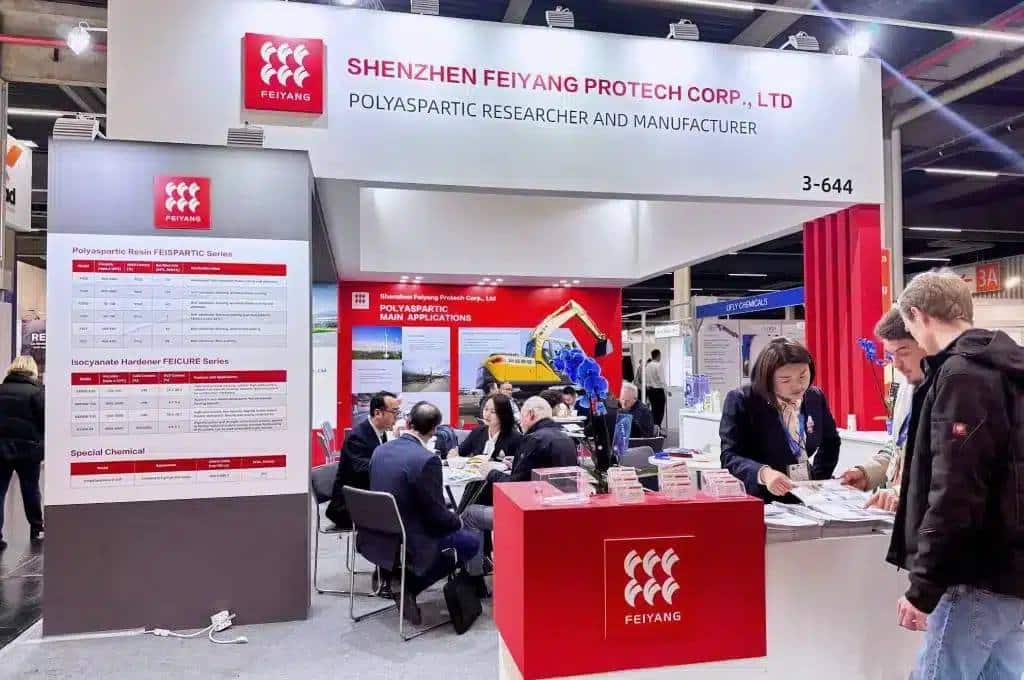
Contact Feiyang Protech to work with a polyaspartic resin manufacturer backed by 30 years of production and export experience. We can help you select the right resin grade, match suitable hardeners, customize formulations for your application, and provide samples, technical data, and hands-on technical support.